
Leave Your Message

China Top 10 Butyl Inner Tube Manufacturers in 2026

China’s Butyl Inner Tube industry is entering 2026 with stronger quality expectations and sharper competition. Manufacturers now serve bicycles, motorcycles, passenger vehicles, trucks, agricultural machines, and industrial equipment. Each application demands different dimensions, pressure ratings, and rubber behavior.

Jean-Dominique Senard, former Michelin managing partner, once said, “The tire is the only point of contact between the vehicle and the road.” That principle also matters inside the tire. A dependable Butyl Inner Tube must retain air, resist heat, bond securely around the valve, and maintain its shape during repeated loading. Small defects can become visible through slow pressure loss, uneven wear, or roadside failure.

This article reviews ten Chinese manufacturers relevant to buyers in 2026. The evaluation considers production experience, compound consistency, mold accuracy, laboratory testing, export capability, certifications, and customer support. Factory scale alone is not enough. A polished website proves little. More useful evidence includes batch records, sample inspections, aging tests, and clear responses to technical questions.

The ranking is not absolute. Supplier performance can change between factories, product lines, and production batches. That limitation deserves attention. Some companies may offer excellent truck tubes but weaker bicycle products. Others may compete strongly on price while providing less transparent documentation.

Readers should verify specifications independently before placing orders. Check valve design, tube thickness, operating temperature, packaging, and compatibility with the intended tire. A reliable shortlist begins with evidence, not promises. This guide aims to make that comparison clearer, more practical, and easier to audit.
China Top 10 Butyl Inner Tube Manufacturers in 2026

Definition and Scope of Butyl Inner Tube Manufacturing in China

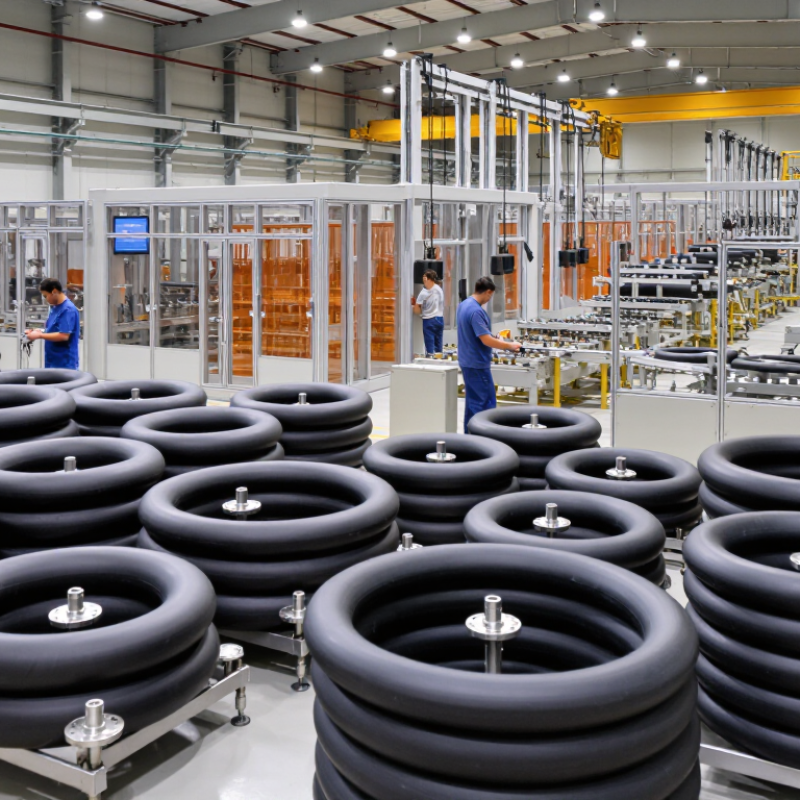
China’s butyl inner tube manufacturing covers the production of air-retaining tubes from butyl rubber compounds. These tubes serve bicycles, motorcycles, passenger vehicles, trucks, and agricultural equipment. The process normally includes material mixing, extrusion, splicing, vulcanization, valve fitting, inflation testing, and packaging. Butyl rubber offers low air permeability and stable performance across changing temperatures. Quality depends on more than the rubber formula. Wall thickness, joint strength, valve alignment, and surface finish also matter.

Factory capabilities vary widely. Some facilities operate automated extrusion lines and digital leak testers. Others still depend on manual inspection at important stages. During supplier evaluations, buyers should examine compound records, mold maintenance, curing temperatures, and batch traceability. A reliable manufacturer can provide test data for air retention, tensile strength, elongation, and aging resistance. Production capacity should be checked against actual equipment, not only stated output.

The scope also includes custom dimensions, valve types, packaging, export documentation, and after-sales quality handling. For a 2026 top-ten review, factory audits and sample testing are more useful than rankings alone. A polished sample may hide inconsistent mass production. That risk is real. Even experienced buyers can overlook storage conditions, where heat and ozone may weaken finished tubes. Supplier comparisons should therefore combine technical evidence, production experience, corrective-action records, and clear communication. Some evaluations remain imperfect, especially when factories provide limited long-term performance data.
Criteria for Ranking the Top 10 Manufacturers in 2026

Ranking the top ten butyl inner tube manufacturers in 2026 requires more than checking annual output. The strongest method combines product performance, factory discipline, and buyer experience. Material consistency deserves close attention. Reliable manufacturers control rubber formulation, wall thickness, valve fitting, and curing temperature. These details affect air retention and service life.

Independent testing should support every major claim. Useful evidence includes tensile strength, elongation, airtightness, aging resistance, and dimensional checks. Certifications can improve confidence, but they should match current production sites and product scopes. We also assess traceability, sample approval, defect records, and corrective actions. Delivery reliability matters too. A capable factory should explain lead times, minimum order quantities, packaging, and replacement procedures clearly. However, a large production capacity does not automatically mean better quality. The scoring model still has blind spots. I would review results when new test data or customer feedback appears.

Tips: Request recent inspection reports, not old certificates. Ask for production samples from different batches. Check valve alignment by hand. Confirm storage conditions before shipment. Compare warranty responses, not only prices. A short factory video is useful, but an audited visit is stronger evidence. Buyers should record test results and revise their supplier list each year. Mistakes happen, even in well-managed plants. The ranking should reflect how manufacturers respond when they do.

China Top 10 Butyl Inner Tube Manufacturers in 2026

Criteria for Ranking the Top 10 Manufacturers in 2026

The ranking framework evaluates manufacturers using practical purchasing and quality factors: product quality and consistency, production capacity, compliance and testing, material performance, delivery reliability, export capability, customization, after-sales support, sustainability, and cost competitiveness. The percentages represent the proposed weighting of each criterion in a 2026 industry assessment and do not identify or compare individual companies.

Profiles of China’s Top 10 Butyl Inner Tube Manufacturers

China’s top ten butyl inner tube manufacturers in 2026 represent a broad manufacturing base. Their profiles differ in scale, specialization, and export experience. Some operate highly automated mixing and extrusion lines. Others compete through flexible production and smaller custom batches. Their products commonly serve motorcycles, passenger vehicles, trucks, agricultural equipment, and industrial trailers.

A reliable profile should examine rubber formulation, wall thickness control, valve bonding, and curing consistency. Strong manufacturers publish test data for air retention, tensile strength, elongation, and heat aging. Factory audits also reveal practical details, such as clean storage areas, calibrated gauges, and traceable batch records. Several leading producers use automated inspection systems to detect pinholes and uneven surfaces. However, no factory is perfect. A polished website cannot replace production evidence, and rankings may overlook smaller suppliers with better technical support.

Tips: Request recent test reports and sample tubes from each shortlisted manufacturer. Check the valve base carefully. It should sit flat, without visible cracking or excess rubber. Ask how rejected products are recorded and handled. Confirm mold compatibility, packaging conditions, minimum order quantities, and delivery schedules before signing an agreement. A useful comparison also includes communication speed and response quality. These details seem minor, but they often affect real operating costs.

China Top 10 Butyl Inner Tube Manufacturers in 2026 - Profiles of China’s Top 10 Butyl Inner Tube Manufacturers

Rank Manufacturing Profile Primary Production Region Main Product Coverage Typical Rim Sizes Material Configuration Applicable Standards Quality and Testing Focus Typical Export Markets Production Strength
1 Profile A Shandong Truck, bus, trailer, agricultural and industrial inner tubes 12–24.5 in Halobutyl or standard butyl compound; replaceable rubber valves GB/T 7036.1; ISO 9001 quality-management framework Air-retention testing, valve bonding, dimensional inspection and leak testing Southeast Asia, Africa, the Middle East and South America High-volume production for commercial-vehicle replacement markets
2 Profile B Jiangsu Passenger-car, light-truck, truck and bus inner tubes 13–22.5 in Butyl rubber with controlled wall thickness and molded valve bases GB/T 7036.1; ISO 9001-based process control Uniformity, vulcanization, joint strength and pressure-retention checks Europe, Central Asia, Southeast Asia and domestic China Flexible production lines suited to mixed-size orders
3 Profile C Zhejiang Motorcycle, scooter, bicycle, light-truck and agricultural tubes 8–20 in Butyl compounds for small- and medium-diameter applications GB/T 7036.1; applicable two-wheel and tire-industry specifications Valve alignment, splice integrity, size accuracy and air-loss testing South Asia, Latin America, Africa and the Middle East Broad small-size catalog and frequent private-label orders
4 Profile D Hebei Truck, agricultural, forklift and off-road equipment tubes 14–24.5 in Heavy-duty butyl rubber with reinforced valve areas GB/T 7036.1; customer-specific technical specifications Load-related durability, valve pull-out resistance and high-pressure testing Africa, Central Asia, Russia-linked markets and the Middle East Strong focus on heavy-duty and replacement applications
5 Profile E Anhui Agricultural, implement, industrial and small-truck inner tubes 12–20 in Butyl rubber with application-specific gauges and valve types GB/T 7036.1; internal batch traceability procedures Compound mixing, wall-thickness consistency and batch sampling Southeast Asia, Africa and domestic agricultural-equipment channels Custom sizing for agricultural and industrial equipment
6 Profile F Fujian Motorcycle, scooter, bicycle and light commercial-vehicle tubes 8–17 in Flexible butyl formulations with standard and angled valves GB/T 7036.1; customer inspection protocols Valve leakage, low-pressure deformation and fatigue testing South Asia, ASEAN countries, Africa and Latin America Competitive small-diameter production and export packaging
7 Profile G Guangdong Bicycle, electric-bicycle, motorcycle and scooter tubes 8–16 in Butyl rubber optimized for compact urban mobility products GB/T 7036.1; purchaser-specific drawings and inspection standards Pinhole detection, valve positioning, package integrity and fit testing Southeast Asia, Europe, North America and Latin America Fast response for small-size and customized valve requirements
8 Profile H Liaoning Truck, bus, mining-support and industrial vehicle tubes 16–24.5 in Heavy-gauge butyl rubber and reinforced valve assemblies GB/T 7036.1; ISO-style inspection and traceability procedures High-load durability, heat aging, pressure retention and dimensional checks Central Asia, Eastern Europe, the Middle East and Africa Specialization in large-diameter and heavy-duty tube applications
9 Profile I Hubei Commercial vehicle, agricultural and industrial inner tubes 12–22.5 in Standard butyl and halobutyl options with multiple valve patterns GB/T 7036.1; buyer-approved quality plans Batch consistency, splice strength, valve torque and air-loss inspection Domestic China, Southeast Asia, Africa and South America Balanced product range for distributors and fleet-maintenance markets
10 Profile J Shanxi Agricultural, industrial, forklift and specialty off-road tubes 12–20 in Butyl rubber compounds with application-specific thickness options GB/T 7036.1; documented process and final-product inspection Load testing, valve adhesion, aging resistance and leakage control Central Asia, Africa, the Middle East and domestic replacement channels Small-batch customization for non-standard industrial applications

Note: The profiles are presented without company or brand names. Product dimensions, standards and market categories reflect commonly documented specifications for Chinese butyl inner-tube manufacturing and should be verified with each supplier before procurement.

Product Range, Quality Standards, and Production Capabilities

China’s top ten butyl inner tube manufacturers in 2026 should be judged by more than factory size. A practical review examines product range, quality systems, and production control. Most capable factories produce tubes for passenger cars, trucks, buses, agricultural equipment, motorcycles, and industrial vehicles. They may also offer different valve types, wall thicknesses, sizes, and packaging options.

QQuality begins with consistent butyl rubber mixing. Reliable plants control compounding, extrusion, splicing, vulcanization, and leak testing. Look for documented ISO 9001 systems and test records linked to each production batch. Suppliers should also identify the standards required in your target market. Certificates alone are not enough. Samples can reveal uneven seams, valve leakage, or poor elasticity. These details matter during installation.

PProduction capability needs closer inspection. Ask about monthly capacity, mold availability, automated inspection, raw material storage, and backup equipment. A factory may report high output, yet struggle with urgent custom orders. That weakness is easy to miss. A careful audit should include warehouse conditions and traceability procedures. Rankings are useful, but they are never perfect; performance can change with materials, staffing, or seasonal demand.

Tips: Request three samples from different batches. Check air retention after several days. Confirm valve dimensions, packaging protection, and inspection records before placing a large order.

How to Compare and Select a Reliable Chinese Manufacturer

Comparing China’s top ten butyl inner tube manufacturers requires more than a price list. A reliable supplier should provide stable dimensions, consistent wall thickness, and secure valve installation. Ask for samples from different production batches. Samples reveal more.

Test each tube for air retention, elasticity, valve alignment, and resistance to repeated inflation. Record results under the same temperature and pressure conditions. Request material specifications, inspection records, and batch traceability. A professional manufacturer should explain its testing process clearly, not hide behind vague certificates. Check whether the factory controls mixing, extrusion, vulcanization, and final inspection internally. Outsourcing every stage may create inconsistent quality.

Factory communication also matters. Discuss minimum order quantities, mold charges, packaging details, lead times, and replacement procedures before signing anything. Ask for photos or videos of actual production areas, then verify them during a live inspection when possible. A low quotation can become expensive after leakage complaints or delayed shipments. Do not rush.

Reliable manufacturers usually answer technical questions with measurements and evidence. They should accept reasonable quality standards and provide a written pre-shipment inspection plan. Independent testing can strengthen confidence, especially for large orders. Still, no audit is perfect. A polished factory visit may not represent every shift or batch. My own comparison would include a small trial order, because assumptions often fail during mass production. Keep communication records, approve a reference sample, and compare the delivered tubes against that sample before expanding the order.